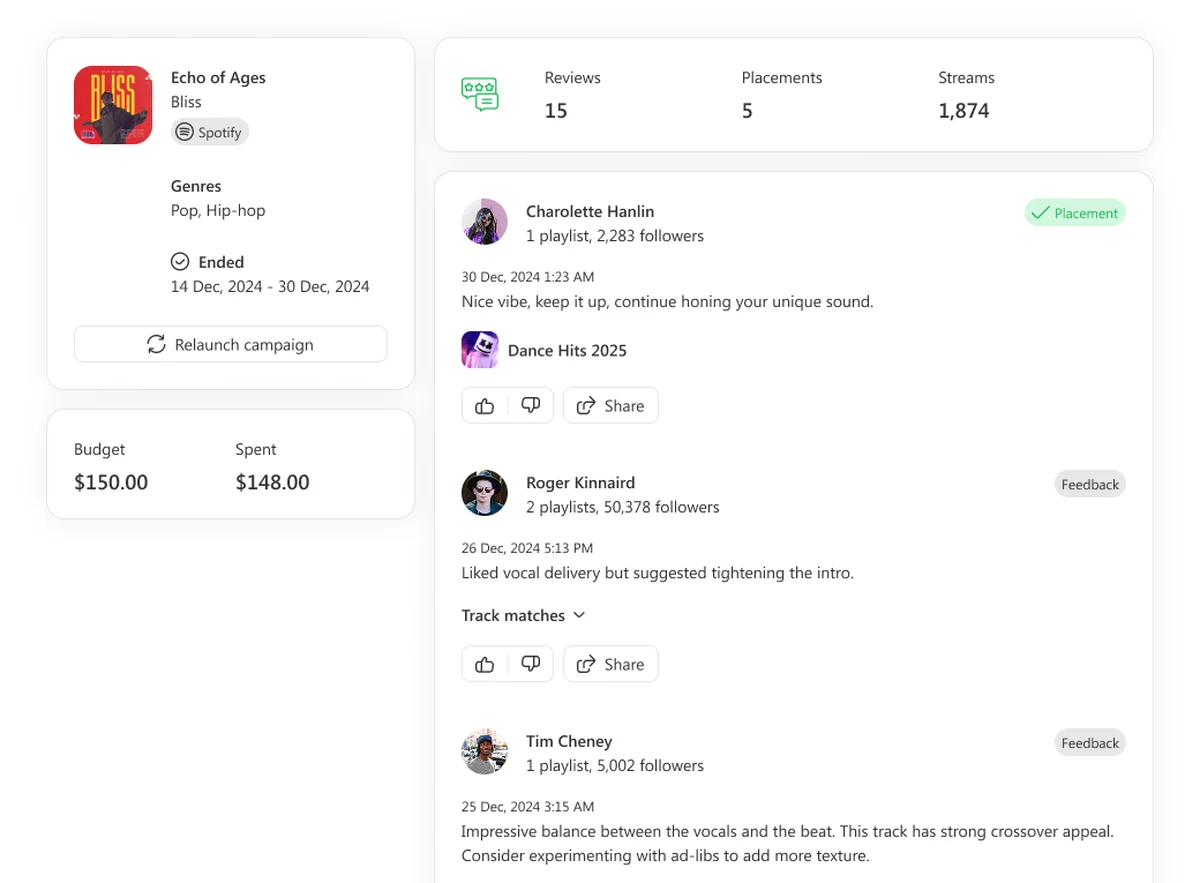
There are six real ways to pay for music promotion, and they have wildly different economics. A $150 curator campaign we tracked returned 5 playlist placements and 1,874 streams. TikTok converts views to Spotify saves at 0.3%. Meta ads buy followers cheapest. Spotify editorial costs nothing and lands 3–5% of the time.
Most "music promotion" is really six different products sold under one label, and they've got almost nothing in common. One buys you a human curator listening to your track. One buys you 15 seconds of a stranger's TikTok. One buys you followers you already half-earned. Confusing them is how artists lose money.
We've run real campaigns through most of these channels, tracked what came back, and published the numbers. Below is what each channel costs, what it realistically returns, and which one to start with.
Key Takeaways
Curator playlist pitching has the best odds per dollar. On the $150 campaign we tracked, 15 curators reviewed the track and 5 added it.
TikTok converts views to Spotify saves at about 0.3%, measured across 31 campaigns. Reach is cheap. Saves aren't.
Meta and Instagram retargeting is the cheapest way to turn existing listeners into followers, from $100.
Spotify editorial is free and lands 3–5% of indie pitches. Pitch it every release, but never lean on it.
Any service guaranteeing a stream count is selling bot traffic. The streams get nulled and your account gets flagged.
Leader of the Music Promo MarketGET 10% OFF First Campaign
SoundCampaign is our top pick because it is the only platform here that sells three channels from one dashboard: Spotify curator pitching, TikTok creator campaigns, and Meta ads. Campaigns start at $80. On the $150 tier we tracked, 15 curators reviewed the track and 5 added it, and every curator who passed still wrote back.
Channels: Spotify playlists, TikTok creators, Meta ads
5,000+ vetted curators in 80+ countries
Written feedback on every pitch, including the passes
Unreviewed pitches credited back automatically
Real-time dashboard showing which curators saw the track
Playlist Push covers two channels, Spotify playlists and TikTok creators, and it has the deepest creator pool of anyone here. If TikTok reach is what you are buying, this is the strongest option on the list. The recurring complaint in reviews is cost per stream, and creator quality gets uneven on the cheaper tiers.
SubmitHub is the widest net here: playlists, music blogs, and YouTube channels, plus a separate Links product that runs Meta ads. The pay-per-pitch credit model lets you hand-pick every recipient, which no other platform on this list allows. Watch the auto-renewals, and note its ad costs run higher than buying the ads yourself.
Channels: playlists, blogs, YouTube channels, Meta ads
Groover is the only platform here that reaches radio, and it is the one to use if your audience is in Europe. It pitches curators, blogs, and stations, and feedback is guaranteed rather than hoped for. The tradeoffs are uneven curator quality and a 14-day reply window that feels slow next to the others.
YouGrow Promo does one channel, Spotify playlist pitching, and it is the cheapest legitimate way to try it. That single focus is the whole pitch: a first campaign with a human to talk to. Some reviews question how active the playlists are, so check the curators before you scale past a test budget.
There are six, and only the first five are legitimate. Knowing which one a service actually sells is the most useful thing you can learn before spending anything.
Curator playlist pitching puts your track in front of people who run their own Spotify playlists. You pay for their time to consider it, and they can say no. This is the only channel where an artist with no audience can get a yes this week.
TikTok creator campaigns pay creators to use your song in a video. It isn't direct streaming promotion, but the spillover into saves and follows is often larger than what playlist pitching produces on its own.
Meta and Instagram ads buy attention directly. Their real strength is retargeting: showing a follow prompt to people who already clicked through to your track once.
Spotify editorial pitching is the free submission form inside Spotify for Artists. A human editor reads every pitch. They place a small fraction of them.
Music PR and blog pitching buys a publicist's relationships with writers and tastemakers. It works, but only above a budget threshold most independent artists aren't anywhere near.
"Guaranteed" streams and placements is the category that isn't one. If a number is promised regardless of whether anyone likes the song, that number is being manufactured.
Paying for any of the legitimate five buys you the same underlying thing. Be clear-eyed about what that is before you spend:
Pros
+Access to gatekeepers you have no relationship with
+A fixed price instead of 10-20 hours of your own outreach
+Written feedback on the track before you finish the next one
+Genre matching that would take you weeks to do by hand
Cons
−You pay for consideration, not outcomes: a campaign that lands badly still costs full price
−None of it fixes a mix that isn't finished
−Every channel has a floor below which it does nothing at all
−The worst operators in the category look identical to the best ones from the outside
Here is every channel priced side by side, ranked by odds rather than by sticker price.
#
Channel
Realistic odds
Time to first result
Best for
What you pay
1
Playlist pitching (curators)BEST ODDS
5 of 15 curators added the track on our tracked campaign
3-14 days
Any finished, correctly-tagged release
$80-$300
2
TikTok creator campaigns
0.3% of views become Spotify saves, across 31 campaigns
2-4 weeks
Tracks with a hook inside 15 seconds
~$200
3
Meta and Instagram ads
30-80 new follows over 14 days
7-14 days
Retargeting people who already heard the track
~$100
4
Spotify editorial pitching
3-5% of indie pitches land
Pitch 14-21 days pre-release
Every release, every time
Free
5
YouTube Shorts and video
0.18% save rate, about half of what TikTok converts
Views arrive fast, saves lag
Releases with a real video behind them
You set the bid
6
Guaranteed streams or placements
Policy violation, not a route
Streams get nulled
No one
$10-$300
1Playlist pitching (curators)
BEST ODDS
$80-$300what you pay
Realistic odds
5 of 15 curators added the track on our tracked campaign
Time to first result
3-14 days
Best for
Any finished, correctly-tagged release
2TikTok creator campaigns
~$200what you pay
Realistic odds
0.3% of views become Spotify saves, across 31 campaigns
Time to first result
2-4 weeks
Best for
Tracks with a hook inside 15 seconds
3Meta and Instagram ads
~$100what you pay
Realistic odds
30-80 new follows over 14 days
Time to first result
7-14 days
Best for
Retargeting people who already heard the track
4Spotify editorial pitching
Freewhat you pay
Realistic odds
3-5% of indie pitches land
Time to first result
Pitch 14-21 days pre-release
Best for
Every release, every time
5YouTube Shorts and video
You set the bidwhat you pay
Realistic odds
0.18% save rate, about half of what TikTok converts
Time to first result
Views arrive fast, saves lag
Best for
Releases with a real video behind them
6Guaranteed streams or placements
$10-$300what you pay
Realistic odds
Policy violation, not a route
Time to first result
Streams get nulled
Best for
No one
Work down it in that order. Editorial is free so it always belongs in the plan, but a 3–5% hit rate can't carry a release on its own. Curator pitching is the one line where money reliably converts into placements, which is why it goes first for most artists.
TikTok buys the biggest raw numbers, though reach and saves are very different animals, and the gap between them is where most TikTok budgets disappear. Meta ads are the cheapest per follower but only work once somebody already knows the song exists, so they belong at the end of the sequence. YouTube sits at roughly half TikTok's save conversion, which makes it a catalog play more than a launch play.
Music PR sits outside that table on purpose. It is the only channel where a small budget is actively worse than no budget, because below roughly $1,500 you're paying for an email blast instead of a relationship. Radio pitching is absent for a different reason: we haven't tested it, so it doesn't get an invented figure.
For playlist placement specifically, a curator pitching platform beats every other channel on odds per dollar. We spent six months running real campaigns through 23 Spotify promotion platforms across six genres. Five delivered placements that still held up 30 days later, and those are the five ranked at the top of this page.
The pattern across all 23: the platforms willing to tell us which curators saw the pitch produced placements that survived the campaign. The ones that kept that hidden showed roughly four times more post-campaign stream decay, which is the fingerprint of inflated numbers.
On one $150 campaign we tracked end to end through SoundCampaign, the track went to roughly 16 genre-matched curators. Fifteen came back with a review, 5 added it to a playlist, and it pulled 1,874 streams over two weeks. That works out to about $0.085 per stream. An independent test by Najinsan, running the same platform against SubmitHub and Groover, landed at $0.09 per stream. Two artists, two different years, effectively the same number.
There's a gap no service advertises: pitches sent versus pitches actually reviewed. Ten of our sixteen curators either passed or never responded. That's normal, and it's exactly why unreviewed-pitch credits matter more than the headline pitch count in a pricing table.
What we didn't like: you're paying for consideration, not outcomes. A campaign that lands badly still costs full price, and there's no version of this where the platform owes you a placement. Go in expecting data and a modest streams bump.
Buy creator videos instead of raw views, and judge the campaign on saves. Across 31 campaigns we measured, totalling roughly 1.4M TikTok views, the conversion rate from view to Spotify save averaged 0.3%, or about 3 saves per 1,000 views.
Hold that number against any TikTok pitch you get. A campaign promising 200,000 views is promising roughly 600 saves at average conversion, and a campaign that delivers 200,000 views and 40 saves has told you the hook doesn't survive being pulled out of context. Painful, but genuinely useful.
Creative quality moves this more than budget does. Songwriter-on-camera videos convert close to 10× better than generic background uses, so the brief you give creators matters more than how many of them you hire. In practice, $200 buys 5–8 creator videos averaging 5K–15K views each.
TikTok now reports direct Spotify attribution, so you can measure this now instead of taking it on faith. Before that shipped, most TikTok promotion claims were unfalsifiable. The mechanics of which sounds travel are covered in TikTok music promotion explained.
They work, but at roughly half TikTok's efficiency at the thing that matters. We pulled three test-catalog tracks used in Shorts and looked at conversion across about 480,000 total views: the YouTube Music save rate came in at 0.18%, around 860 saves, against TikTok's 0.32% on comparable material.
So YouTube is the weaker launch channel and a reasonable catalog channel. The saves it does produce may be worth more per listener, because YouTube Music subscribers skew slightly older and listen longer per session, so cost per listener-minute can favour YouTube even when the headline save rate looks worse. The fuller comparison is in YouTube ties Shorts views to song saves.
Be careful with the services selling view counts. A view count is the easiest metric on the internet to fake and the least connected to anything you care about. If a service can't tell you whether views turned into saves or subscribers, what it is selling you is a number with no audience behind it. The same test applies here as everywhere else on this page: ask whether the audience could have declined.
There is no real curator-pitching market outside Spotify, so "Apple Music promotion" almost always means editorial pitching through your distributor plus whatever traffic you drive from elsewhere. Apple's editorial team doesn't take open submissions the way Spotify for Artists does.
That makes the practical approach for Apple Music, Amazon Music, and Deezer identical: get the release delivered early enough for your distributor to pitch it, make sure the metadata and genre tags are right, and accept that the discovery work happens on the platforms with open doors. Apple has been expanding editorial coverage in specific niches, including neoclassical and ambient on Apple Music Classical, which matters if that's your genre.
Anyone selling you "Apple Music playlist placement" as a product is either pitching user-made playlists, which have a fraction of the reach, or making it up.
Yes, but as a converter rather than a discovery channel. A $100 Meta retargeting budget over 14 days generated 30–80 new follows in our campaigns, which is the cheapest per-follower number of any channel here.
The reason it's cheap is also the reason it can't go first. Retargeting works on people who already showed interest, so you need a discovery channel feeding it. Artists who start with Meta ads before anyone has heard the track are paying to introduce themselves to strangers, which is the most expensive thing Meta can do for you.
Ask one question: can the audience say no? Every legitimate music promotion service sells you access or consideration. Every fraudulent one sells a guaranteed outcome, and the only way to guarantee an outcome is to manufacture it.
Three transactions get conflated, and the difference matters:
Paying for pitching or review. Allowed. You buy a curator's time, and they can decline.
Paying for the placement itself. Not allowed. That is payola, and the playlists that sell slots tend to have hollow follower counts anyway.
Buying streams. Not allowed, and the most damaging. This is bot traffic.
Run the arithmetic and the offers fall apart on their own. Our tracked campaign produced streams at about $0.085 each through legitimate pitching. An ad offering "10,000 streams for $30" is pricing streams at $0.003, which is roughly what Spotify pays out per stream. Nobody sells real listening at cost, because there's no margin in it. What is being sold is bot traffic, and your account absorbs the consequence while the seller keeps the fee.
A compliant model looks like the one SoundCampaign runs: you pay for curator review time, curators genuinely decline (10 of our 16 did), and pitches nobody reviewed get credited back automatically. The refund mechanism is the tell. A service that has to give money back when a curator ignores you is a service where the curators are real people who can ignore you.
Worth knowing how the complaints read, too. Search any of these platforms and you will find posts calling them scams. Read them closely and most mean "my track didn't get placed and I want my money back," which describes a disappointment and not a fraud. Learn to tell those apart before you buy anything in this category. Real saves are also the only thing the recommendation engine rewards, which is covered in how the Spotify algorithm actually works.
Three are worth real time, and all three are things platforms already give you. Free promotion is slower and caps out lower, but at a $0 cost basis the return per hour is often better than a paid campaign.
Spotify editorial pitching. Free, five minutes, one pitch per release through Spotify for Artists, and a human editor reads it. The 3–5% hit rate is low, but nothing else here is free and can still put you on a flagship playlist. The pitch copy decides a lot of it, broken down in how to pitch Spotify editorial playlists.
Manual curator outreach. Find playlists through Spotify's "Discovered on" tab, track down the curator, and write individually. Budget 10–20 hours per release and expect a low reply rate until you have contacts. In niche genres with an actual scene, this outperforms any paid platform, because the relationship is the asset and nobody can sell you one.
Your own release mechanics. A pre-save page, correct genre tags, and a filled-out artist profile cost nothing and change how every other channel performs. Curators check your profile before they add you. An empty one reads as an artist who won't promote the playlist back.
What is not worth your time: the "free music promotion" services that blast your track to hundreds of playlists at once. Free submission at that volume means nobody is listening, and the playlists accepting it are the ones nobody follows.
Split it across channels rather than betting it on one, and keep the total small enough that the campaign is a test. For a $500 budget, the allocation that has worked in our campaigns is $150 to curator pitching, $200 to TikTok creators, $100 to Meta retargeting, $20 to a pre-save page, and $30 held back.
That reserve matters more than it looks. At day five, whichever channel is outperforming gets the extra $30. You're not trying to predict which channel wins. You're trying to find out.
Realistic 30-day outcome for $500: 2,500–6,000 new listeners, 80–250 new followers, and 150–400 saves. What you shouldn't expect is to break even. At a blended payout around $0.003 to $0.005 per stream, $500 of royalties means roughly 167,000 streams, far above what $500 of promotion delivers. What you are buying is an audience. The followers are what make the next release cheaper to promote.
Open Spotify for Artists and look at saves, not streams. Streams tell you people arrived. Saves tell you they mean to come back, and that's the number the recommendation engine reads.
Four things to check 30 days after the campaign ends:
Source of streams, broken out by playlist. This tells you which specific placements did the work. Most campaigns have one or two carrying almost everything, and knowing which ones means your next release starts with a shortlist instead of a cold pitch.
Saves per placement. A playlist that sent 400 streams and 2 saves sent you traffic. One that sent 90 streams and 25 saves found your actual audience. The second curator is worth pitching again; the first is worth dropping.
Follower delta. Followers are the input to Release Radar next time, so this is the metric that compounds across releases instead of resetting each time.
Post-campaign decay. The fraud check. Real placements keep streaming for weeks after the campaign ends. Bot traffic falls off a cliff around hour 24. In our testing, the platforms that hid curator identities showed roughly four times more decay than the ones that did not. If your analytics look like that pattern, ask for a refund and stop using the service.
Here's the part I go back and forth on. A campaign can be a commercial disappointment and still be a good purchase, if what it bought you was a reliable read on whether the song connects. I'm not sure that framing helps an artist who just spent rent money on it, but it's true. A campaign that produced 5 placements and almost no saves has told you something worth $150 about the track, even though it won't feel that way at the time.
Match the channel to whatever you are actually missing, which is rarely the one that sounds most impressive.
No audience, finished track, need placements. Curator pitching. The only channel that produces a result without an existing following, and $150 is enough to learn something real.
A hook that works out of context. TikTok creator campaigns. At 0.3% average conversion, this buys the widest reach per dollar of anything here, but brief the creators properly.
Existing listeners who never followed you. Meta retargeting. Cheapest followers on the list, and followers feed Release Radar on your next release.
A finished music video. YouTube. Half TikTok's save rate, but the listeners it does send tend to stay longer.
Every release, no exceptions. Spotify editorial. Free, five minutes, and editors see your name even when they pass.
A genuine story and $1,500+. Music PR. Below that number, put the money in paid channels instead.
A thin-supply genre like metal or experimental. Manual outreach, not platforms. Paying any service to pitch curators who don't exist in your genre is the most predictable way to waste $150. Check genre coverage before you buy and treat a vague answer as a no.
For most independent artists releasing a single, the honest answer is playlist pitching first, editorial alongside it because it is free, and retargeting once there is somebody to retarget.
For playlist placement, SoundCampaign gives the most reliable return per dollar: on the $150 campaign we tracked, 15 curators reviewed the track and 5 added it, producing 1,874 streams. Playlist Push is the better pick for TikTok creator reach, and SubmitHub if you want to hand-pick every curator yourself.
How much do music promotion services cost?+−
Curator pitching starts at $80 on SoundCampaign and typically runs $150 for a single. SubmitHub sells pitches individually as credits, TikTok creator campaigns through Playlist Push start near $200, and Meta retargeting works from $100. Spotify editorial pitching is free. Music PR under roughly $1,500 rarely lands coverage worth the spend.
What is the best marketing for music promotion?+−
Layering two or three channels beats spending everything on one. Splitting $500 across curator pitching on SoundCampaign, TikTok creators through Playlist Push, and Meta retargeting produced 2,500–6,000 new listeners and 80–250 followers in 30 days in our campaigns. Discovery has to come before retargeting, because retargeting needs an audience to retarget.
Where is the best place to promote my music?+−
Independent Spotify curator playlists, reached by pitching through a platform like SoundCampaign, SubmitHub, or Groover. They are the only route where an artist with no audience yet can get a yes this week. Spotify editorial is free but lands 3–5% of indie pitches, and algorithmic playlists cannot be pitched at all.
How many Spotify streams do you need to make $1000?+−
Roughly 200,000 to 330,000 streams, at the $0.003 to $0.005 blended per-stream payout reported for 2026, where the median sits near $0.0033. This is why promotion should be judged on listeners, saves, and followers gained rather than on recouping the spend through royalties.