
Groover Review 2026: Is It Legit, and Is It Worth It?
Groover is legit: you pay €2 per curator for guaranteed feedback, and your credits come back if nobody replies in 7 days. Whether it's worth it depends on what you need besides playlists.
Short answer: Groover is legit. You pay real curators, blogs, radio hosts and labels for a guaranteed reply, not for a placement, and if someone doesn't answer within 7 days your credits come back. A contact costs about €2. Whether that's worth it depends on whether you want feedback and reach beyond Spotify playlists, or just playlist adds.
A lot of the anger in Groover's one-star reviews comes back to one point: a rejection still costs you. Once you know that going in, the rest of the pricing is easy to judge. If it turns out Groover isn't for you, the alternatives are further down.
Key Takeaways
- Groover is a legitimate pay-for-feedback platform, rated 4.2 from 1,637 reviews on Trustpilot.
- A contact costs 2 Grooviz (€2). Some top curators cost 4 or 6. Packs save up to 20%.
- You pay for a reply, not a placement. Credits come back only if a contact doesn't reply within 7 days.
- Its reach goes past playlists: 3,000+ curators and pros, including radio, labels, media and 243 social media influencers.
- If you only want playlist adds, SubmitHub's free standard credits let you test for nothing first.
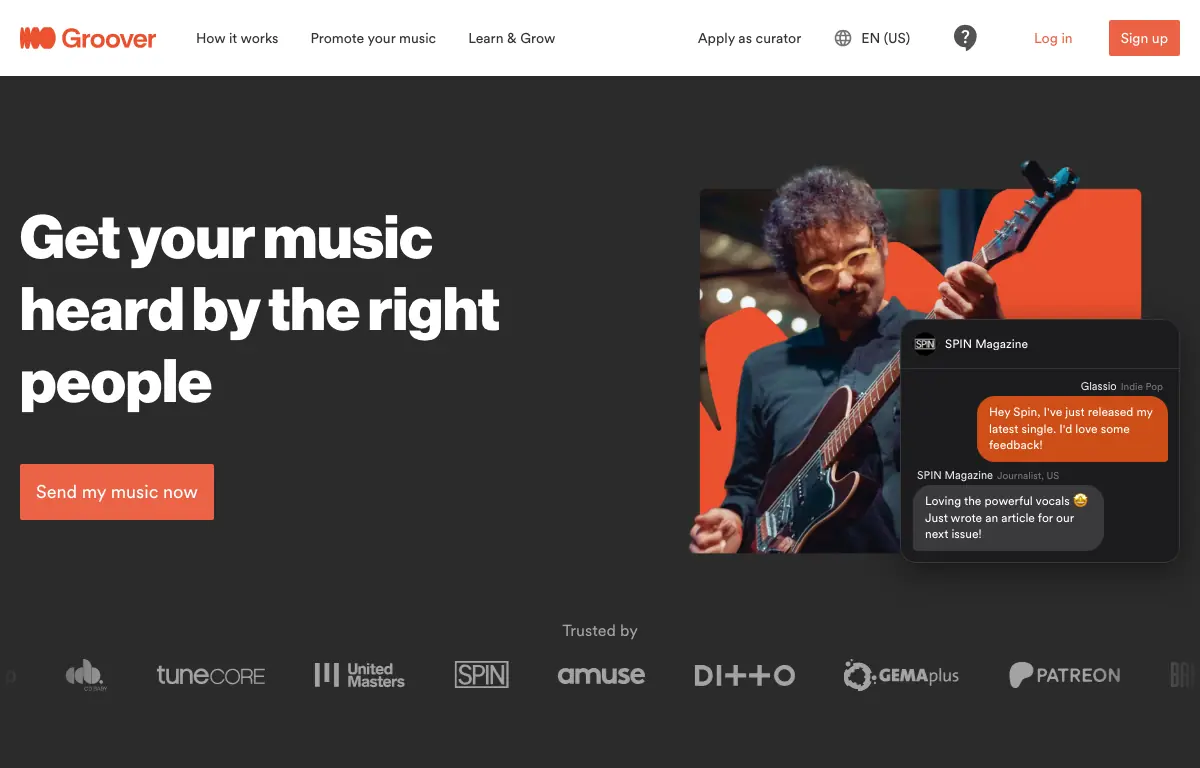
Is Groover legit?
Yes. Groover launched in 2018 at the MaMA Music & Convention, joined Techstars the same year, and says more than 600,000 artists and pros have used it. It has a 35-person team with offices in New York and Paris, and it raised an $8 million Series A. The model is the one Playlist Push, SubmitHub and SoundCampaign use: you pay for a curator's time to listen and respond, not for a placement.
Groover is direct about that. Its Spotify page states that "Placement is never guaranteed," and that every playlist curator is manually reviewed and confirmed free of artificial streams before receiving a track. A service that promises placements or stream counts is either buying the slot or faking the plays. Groover sells neither.
Reviewers mostly agree, though they split hard. On Trustpilot, Groover holds a 4.2 TrustScore from 1,637 reviews: 80% five-star, 4% four-star, 2% three-star, 3% two-star and 11% one-star. Not much sits in the middle. The one-star reviews rarely allege fake streams. They're mostly about paying for rejections, and about feedback that feels generic or comes from curators outside the artist's genre. Trustpilot also shows Groover has replied to 21% of its negative reviews.
C
Carma
United StatesOctober 25, 2026
Groover is a game changer...
Groover has been a game changer for my Music. I am learning and improving from the insight I glean. 99% of the curators are kind, honest and many give valuable feedback. Groover is assisting in bringing my Music out of the closet and into the spotlight! I can't thank you enough.

Toby Zambetti
United StatesAugust 29, 2026
I spent about $80 submitting one track…
I spent about $80 submitting one track to 28 curators through Groover. Every submission was rejected. I did receive feedback, but none of it led to a placement or meaningful promotional result. My main issue is that the service can feel misleading for independent artists: you pay for curator feedback, not for actual promotion or playlist consideration that produces results.
Both reviews describe the same product working as designed. One artist wanted feedback and got it. The other wanted placements and got feedback instead.
How does Groover work?
You pick the curators and pros yourself, send each one your track with a short pitch, and each one owes you a reply within 7 days.
- Choose your contacts. Groover lists 3,000+ curators and pros, filterable by genre, country and type. Groover also suggests contacts for your track, but the choice is yours.
- Add your track and a pitch. Groover accepts Spotify, YouTube, SoundCloud, Deezer and Audiomack links, and private or unlisted links work. Unfinished, unreleased, scheduled and older catalog tracks are all accepted.
- Get a reply. Each contact replies with written feedback, a playlist add or a share. Groover says most reply within 72 hours.
- Get credits back for silence. Anyone who hasn't replied after 7 days costs you nothing. The Grooviz go back to your wallet.
The contacts fall into three groups, in Groover's own terms. Visibility curators are media, blogs, radio, playlisters and YouTube or Twitch channels. Partners are labels, bookers, managers, sync supervisors and publishers. Advice covers coaches, mentors and other pros who give production or career feedback.
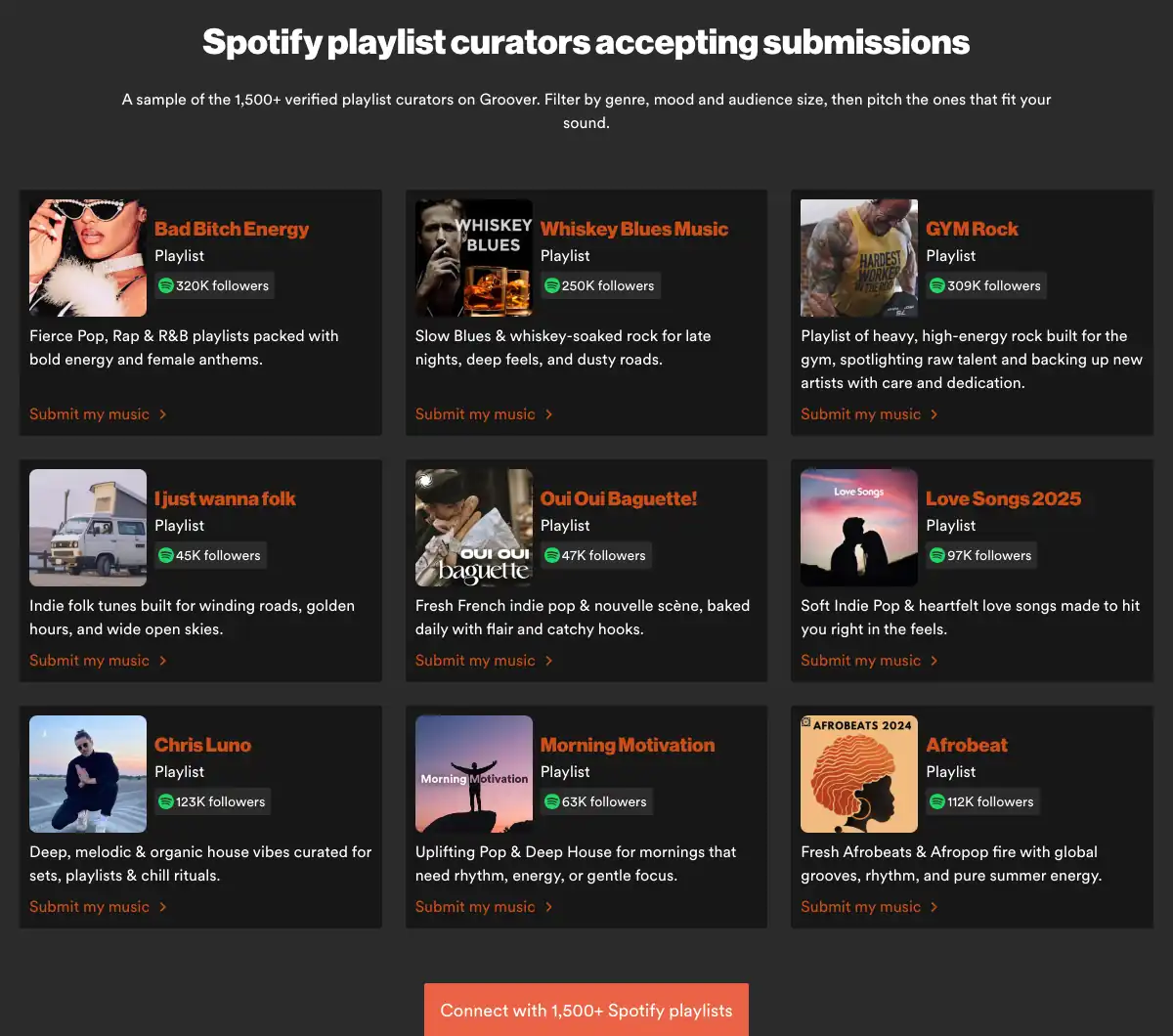
For Spotify specifically, Groover lists 1,500+ verified playlist curators. You can browse them, and see their playlists, before you spend anything.
How much does Groover cost?
Groover runs on credits called Grooviz. One Grooviz costs €1 including tax, about $1.07, and contacting one curator or pro costs 2 Grooviz. A few top curators cost more, usually 4 or 6 Grooviz, and the price shows when you select them. There's no subscription and no entry fee.
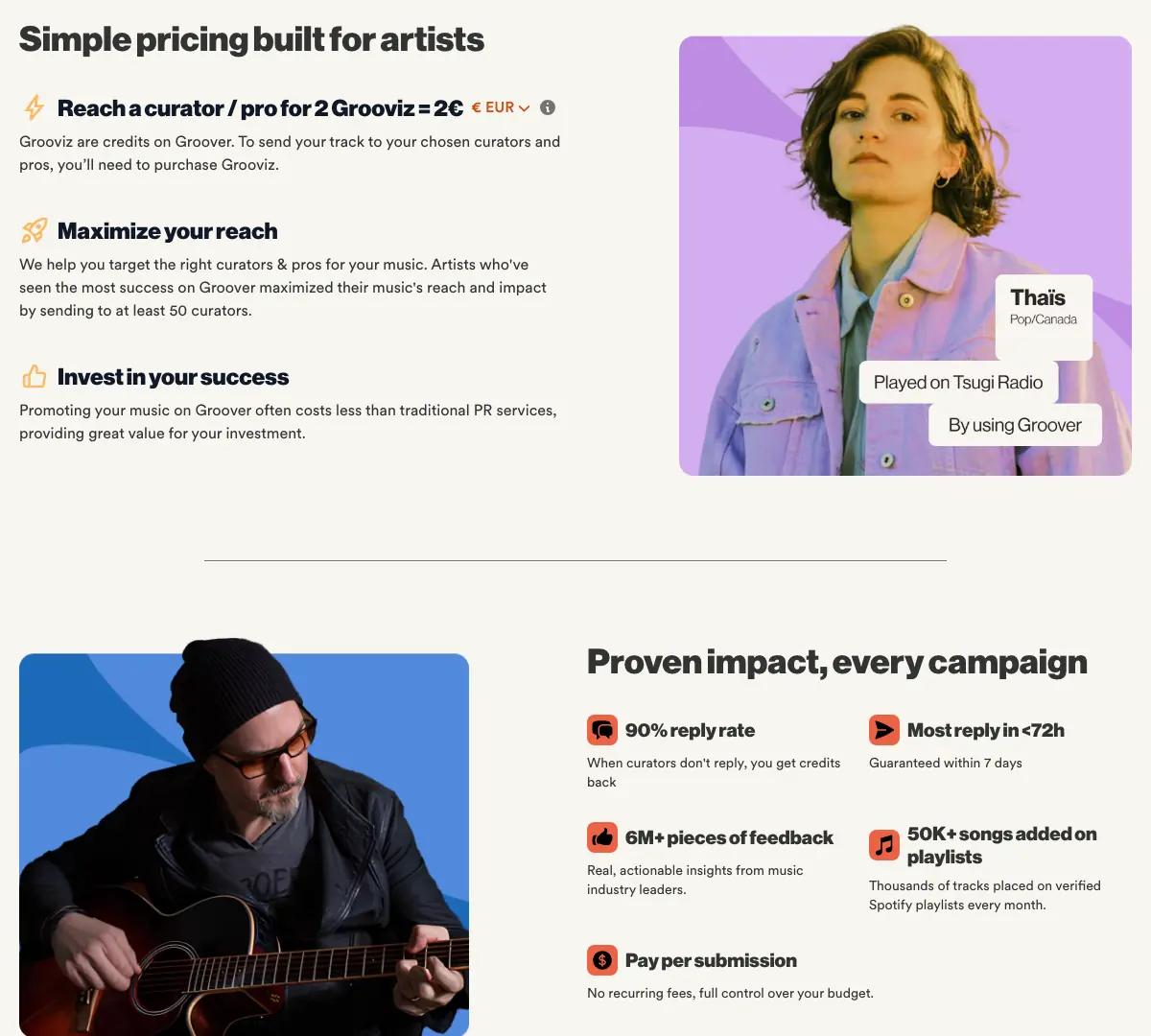
The rest of the pricing, per its pricing page:
- Packs save up to 20%. They start at €47, and credits never expire, so you can spread one pack across several releases.
- Groover suggests at least 50 contacts, and says its most successful campaigns use 50 to 100. That's 100 to 200 Grooviz, roughly €100 to €200 before any pack discount.
- The minimum payment is €10 or €20, depending on your location, according to Groover's terms.
- No reply, credits back. If a contact doesn't respond within 7 days, the Grooviz return to your wallet automatically. Groover's pricing FAQ puts its average answer rate at over 85%.
What the credit-back does not cover is a reply you didn't like. A curator who listens and declines has done the job you paid for, and the €2 is spent.
What does Groover do well?
Reach beyond playlists. Groover's network covers blogs, radio stations, labels, bookers, sync supervisors and 243 social media influencers, as well as Spotify playlists. If you want a write-up, a radio play or a label's ear, a playlist-only service can't get you there.
A reply from every contact, or your credits back. Every contact owes you a response within 7 days. Silence costs nothing, so you only pay for curators who engage.
Control over every euro. You choose each contact and see its price before sending. There's no package to buy and no minimum campaign size beyond a €10 or €20 minimum payment.
Any stage of a track. Unfinished demos and back-catalog songs are accepted, which makes Groover usable for feedback before release as well as promotion after it.
What would we change about Groover?
Paying for "no". It comes up again and again in the one-star reviews on Trustpilot. Groover is clear on its own pages that you pay for feedback, but plenty of artists still arrive expecting promotion. A rejection with two lines of feedback costs the same €2 as a playlist add.
Generic feedback. Several one-star reviews describe replies that read as copy-pasted. One reviewer wrote that responses were "mostly copy / pasted, generic feedback."
Genre matching on suggested lists. Several one-star reviews say curators from Groover's suggested lists rejected tracks as outside their genre. Since a rejection is paid, a poor match costs real money. Check each profile yourself.
Pros
- Reaches blogs, radio, labels and bookers as well as playlists
- A reply guaranteed within 7 days, or credits back
- You choose and price every contact individually
- Credits never expire, packs save up to 20%
- Accepts unfinished and back-catalog tracks
Cons
- Rejections cost the same as placements
- Feedback quality varies, and some reviewers call it generic
- Suggested curator lists can include genre mismatches
How do Groover curators get paid?
Groover's terms spell it out. Of the 2 Grooviz you spend on a contact, the curator gets 1 and Groover keeps 1, and only once the curator gives feedback. Top curators with a badge are paid a different amount.
Curators can turn Grooviz into euros at €1 each, from 20 Grooviz for a first withdrawal and 50 for later ones, but only with professional status. Groover may charge a fee for a second withdrawal in the same month. They can also keep the Grooviz or transfer them to another Groover wallet.
That split keeps the model honest for artists. Curators are paid to reply, whether or not they add you, so a placement still has to be earned. The flip side is that €1 per reply doesn't buy much listening time, which helps explain the complaints about generic feedback.
Groover vs SubmitHub: which should you use?
Groover is the broader network, with a longer but guaranteed reply window. SubmitHub is the cheaper way to test, and it sticks to playlisters, blogs and influencers.
- Who you reach. Groover lists 3,000+ curators and pros, including radio, labels, bookers and sync supervisors. SubmitHub lists 1,765 curators and describes its network as Spotify playlisters, music bloggers and influencers.
- What it costs. A Groover contact costs about €2. SubmitHub's standard credits are free, two every four hours, and premium credits start at $1 and drop to $0.78 in bulk. Each SubmitHub curator sets their own price in credits.
- What you're guaranteed. On Groover, every contact must reply within 7 days or your credits come back. On SubmitHub, premium curators must respond within 72 hours, listen for at least 60 seconds, and approve the song or explain why in at least 20 words, or the credit comes back. Standard credits carry no such requirement.
- Influencers. SubmitHub takes influencer submissions separately, on premium credits only. Groover lists 243 social media influencers you pitch one by one, like any other contact.
Pick Groover if you want radio, press or label contacts, or written feedback from a wide range of pros. Pick SubmitHub if your goal is playlist adds and you want to test for free before you spend. Our SubmitHub review goes deeper.
What are the best Groover alternatives?
The common complaints about Groover are paying for rejections and thin feedback, and some artists just want streams rather than opinions. Here's how the alternatives compare, based on their own published terms.
| Platform | How you pay | If a curator doesn't respond | Beyond Spotify playlists | Starts at | Visit Site |
|---|---|---|---|---|---|
 Groover | 2 Grooviz (€2) per curator or pro, more for top-tier ones | Credits back after 7 days | Blogs, radio, labels, bookers, 243 social media influencers | €2 per contact | |
 SoundCampaign | Only for completed reviews | Credited back | TikTok and Meta campaigns from the same budget | $80 | Visit |
 SubmitHub | Credits, per submission | 72-hour response window; cancel a pending pitch for credits back | Blogs, plus separate influencer submissions | Per submission | Visit |
 Playlist Push | Per review, from a campaign budget | Credited back after 14 days | TikTok creators, from $350 | $280 | Visit |
Groover€2 per contactstarts at
- How you pay
- 2 Grooviz (€2) per curator or pro, more for top-tier ones
- If a curator doesn't respond
- Credits back after 7 days
- Beyond Spotify playlists
- Blogs, radio, labels, bookers, 243 social media influencers
$80starts at
- How you pay
- Only for completed reviews
- If a curator doesn't respond
- Credited back
- Beyond Spotify playlists
- TikTok and Meta campaigns from the same budget
Per submissionstarts at
- How you pay
- Credits, per submission
- If a curator doesn't respond
- 72-hour response window; cancel a pending pitch for credits back
- Beyond Spotify playlists
- Blogs, plus separate influencer submissions
$280starts at
- How you pay
- Per review, from a campaign budget
- If a curator doesn't respond
- Credited back after 14 days
- Beyond Spotify playlists
- TikTok creators, from $350
- SoundCampaign is the closest swap if what you want is Spotify placements on a fixed budget: campaigns start at $80, you only pay for completed reviews, and TikTok and Meta campaigns run from the same budget. See our SoundCampaign review.
- SubmitHub lets you test for free with standard credits, and premium credits cost $1 or less. See our SubmitHub review.
- Playlist Push suits bigger budgets: Spotify campaigns from $280 and TikTok creator campaigns from $350. See our Playlist Push review.
For the full ranking, see best Spotify promotion services.
When should you stay with Groover?
Stay with Groover if playlists are only part of what you want. Radio stations, blogs, labels, bookers and sync supervisors are all on the same platform, and each one owes you a reply. That mix is the reason to pick it.
It also makes sense if you value the feedback itself. If you're still shaping a track, or testing which single to lead with, a reply from every contact is worth paying for even when the answer is no.
Who is Groover best for?
You want press, radio or label ears, not just playlists. Groover. Its network includes those contacts, not just playlisters.
You want honest notes on an unfinished track. Groover's advice contacts and its acceptance of demos fit that well.
You want playlist adds and streams, not feedback. Start with SubmitHub's free standard credits, or a playlist-focused service that only charges for completed reviews, such as SoundCampaign.
You want TikTok creator campaigns next to playlists, and have $350+ to spend. Playlist Push.
Related reading
FAQ
Is Groover legit?
Yes. Groover has run since 2018 and pays curators and music pros for their feedback, not for placements, and it states that placement is never guaranteed. It holds a 4.2 TrustScore from 1,637 Trustpilot reviews. The one-star reviews complain about generic feedback and curators outside their genre, not about fake streams.
How much does Groover cost?
Contacting one curator or pro costs 2 Grooviz, and 1 Grooviz costs €1 including tax, so about €2 per contact. Some top curators cost more, usually 4 or 6 Grooviz. Packs start at €47 with discounts of up to 20%, credits never expire, and if a contact doesn't reply within 7 days the credits come back.
Is Groover worth it?
It's worth it if you want feedback and reach beyond Spotify playlists: blogs, radio, labels, bookers. You pay for a reply, not a placement, so a 'no' still costs €2. If all you want is playlist adds and streams, SubmitHub's free standard credits are a cheaper place to start.
Is Groover better than SubmitHub?
It depends on who you need to reach. Groover is broader: radio, labels, media, bookers and sync supervisors sit alongside 1,500+ playlist curators, and every contact owes you a reply within 7 days. SubmitHub is cheaper to test, with free standard credits and premium credits from $1 or less, and premium curators must respond within 72 hours.
What is the best Groover alternative?
For Spotify pitching on a set budget, SoundCampaign starts at $80, charges only for completed reviews and runs TikTok and Meta campaigns from the same budget. SubmitHub suits artists who want to test for free first. Playlist Push starts at $280 and adds TikTok creator campaigns from $350.
Newsletter
The MelodicMind brief
One short email a week. New reviews, music-industry news, and what we're working on. Free, unsubscribe in one click.
Related reading