How to Get on Spotify Playlists in 2026
There are exactly three legitimate ways onto Spotify playlists, and they have wildly different odds. A ~$150 curator campaign lands about 5 placements. Editorial lands 3–5% of the time.
Short answer: pitch independent curators first through SoundCampaign, pitch Spotify editorial second, and let the algorithmic playlists follow from both. Curator pitching is the only route where an artist with no audience yet can get a yes this week, at roughly $150 for up to 15 curator pitches and about 5 placements. Editorial is free and worth doing on every release, but it lands 3-5% of the time, so it can't be your whole plan. Nothing you can buy will put you on Discover Weekly.
Those are the only three legitimate routes onto a Spotify playlist. Everything else being sold to you is one of them repackaged, or it's a policy violation. The odds gap between the three is the part nobody publishes, and it's what should change how you plan a release.
Key Takeaways
- Independent curator pitching returns about 5 placements per ~$150 campaign, the most reliable route for an artist without an audience yet.
- Spotify editorial pitching is free but lands only 3–5% of indie pitches. Do it every release, never rely on it.
- Algorithmic playlists can't be pitched. They react to save rate and followers, which curator placements help produce.
- Any service guaranteeing streams or placements is violating Spotify's terms. The streams get nulled and your account gets flagged.
Want a real curator listening to your track this week?
5,000+ vetted curators across 80+ countries. Whatever you make, someone in that network is probably playing it already.
What are the three ways to get on Spotify playlists?
Every real path onto a Spotify playlist is one of three things, and knowing which one you're buying prevents most of the money artists waste here.
Independent curator playlists are run by people: bedroom tastemakers, blogs, small labels, genre communities. Some have 200 followers, some have 200,000. You reach them by pitching, either manually or through a platform that handles the introductions. This is the only route where an unknown artist can reliably get a yes.
Spotify editorial playlists are programmed by Spotify's own editors. Think New Music Friday, Fresh Finds, and the genre flagships. You get one pitch per release through Spotify for Artists, it's free, and a human reads it. They place a small fraction of what they receive.
Algorithmic playlists are Release Radar, Discover Weekly, Radio, and Autoplay. Nobody programs these and nobody accepts pitches for them. They respond to how listeners behave around your track, mostly save rate, completion, and follower growth.
The first two are things you do. The third is what happens once the first two are working, which is why the order here matters.
What does each route actually cost, and what are your real odds?
Here is the honest comparison, with the numbers most guides leave out.
| Route | What you pay | Realistic odds | Time to first placement |
|---|---|---|---|
| Curator pitching (paid platform) | ~$150 for up to 15 pitches | ~5 placements per campaign | 3–14 days |
| Curator pitching (manual outreach) | $0, plus 10–20 hours | Low reply rate with no existing relationship | 2–6 weeks |
| Spotify editorial | Free, ~5 minutes | 3–5% of indie pitches | Pitch 14–21 days pre-release |
| Algorithmic (Release Radar, Discover Weekly) | Free, earned | Not pitchable, driven by saves and followers | 7–28 days post-release |
| "Guaranteed" placements or bought streams | $10–$300 | Policy violation, not a route | Streams get nulled |
Work down that table in order. Editorial is free, so you always pitch it, but at 3-5% it can't carry a release on its own. Curator pitching is the one line where spending money reliably produces placements, which is why it goes first for most artists. Algorithmic placement comes last because you can't act on it directly, you can only earn it. The bottom row is there because buying streams is still the most common way artists wreck their own catalog.
How do you pitch independent curators, and why start here?
Start with independent curators. They're the only route where an artist with no audience can still get a yes this week. Editorial needs a track record you may not have yet, and algorithmic placement needs listener signals you don't have yet either. Curators just need a song that fits their playlist.
What actually decides it:
Genre accuracy beats genre ambition. A curator running a lo-fi playlist will skip your indie-folk track in four seconds. Tag honestly and pitch narrowly. The most common self-inflicted wound here is pitching a wide net of loosely-related playlists and reading the rejections as a verdict on the song.
Your artist profile is the pitch. Curators check it. An empty Spotify profile with no photo, no bio, and one track reads as someone who won't promote the playlist back. Fill it in before you pitch anything.
A reason to care, in one sentence. Curators are choosing between dozens of tracks that all technically fit. The story is what breaks the tie.
You can do this manually. Find playlists via Spotify's "Discovered on" tab, track down the curator's contact, and write to each one individually. It works, and in niche genres with a real scene it works better than any platform, because the relationship is the asset. Budget 10-20 hours per release and expect a low reply rate until you've built up contacts.
The alternative is a platform that already has curator relationships and handles the introductions. We've spent real money on SoundCampaign, and at roughly $150 the platform reaches up to about 15 genre-matched curators, of which roughly 5 typically add the track.
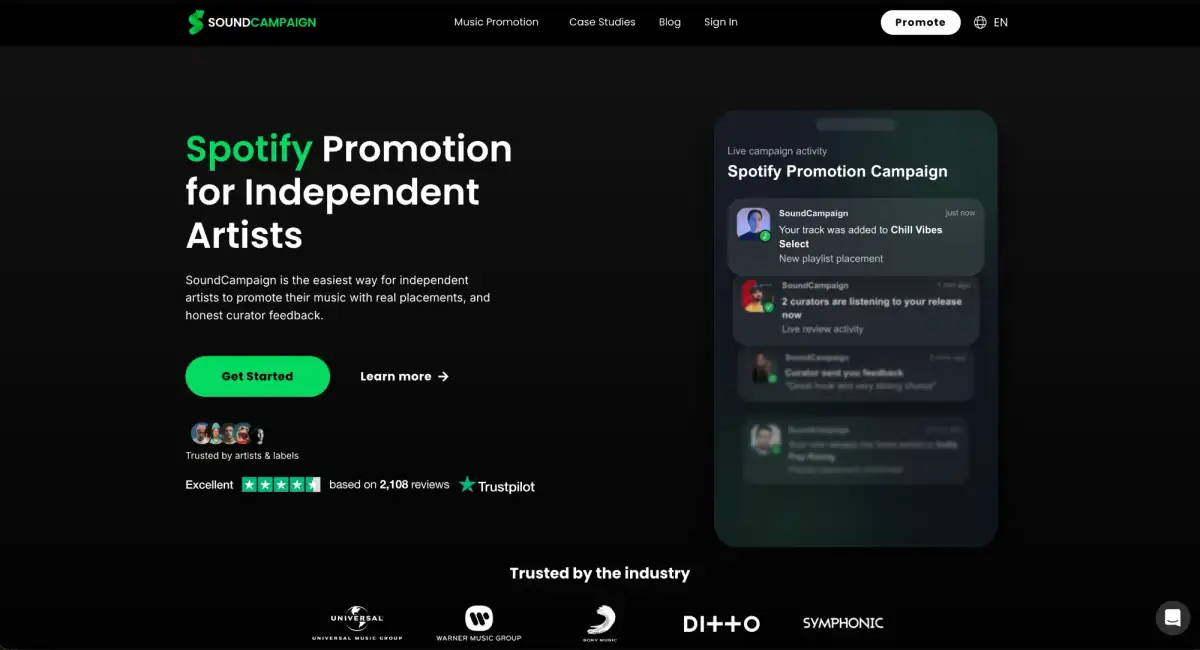
That feedback line in the screenshot is the part I'd actually pay for. On a platform campaign the curators who pass still write back, which is something cold outreach almost never gives you. A curator telling you the chorus doesn't land until 0:50 is worth more than the placement you missed. If you want to run one, SoundCampaign's Spotify promotion is the campaign type described above.
Here's what setting one up actually looks like, start to finish:
1. Pick a campaign type. app.soundcamps.com/create opens straight to this, no account yet.
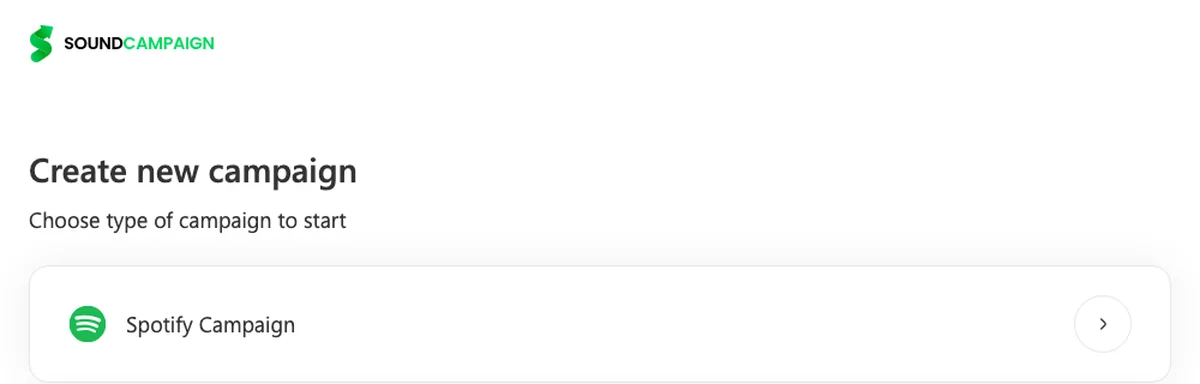
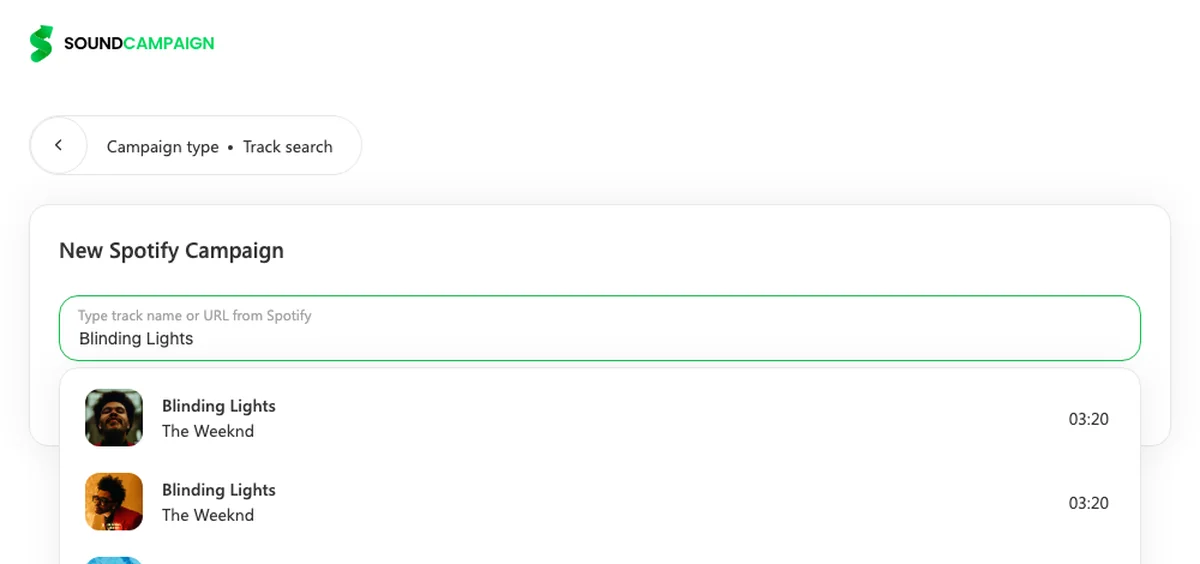
2. Search your track by name or Spotify URL.
3. Set your genres and budget. The slider shows curator reach and estimated campaign reach as you move it, so you see what $150 buys before you commit to it.
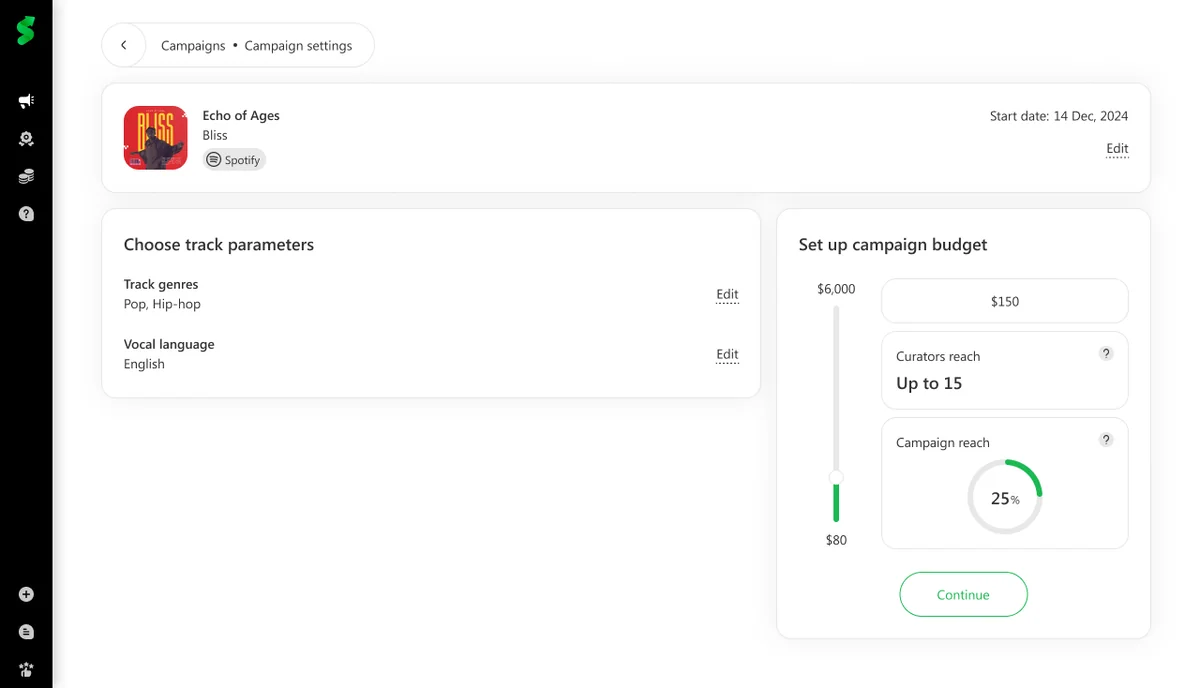
That $150 tier is the exact one we tracked.
What the results actually look like:
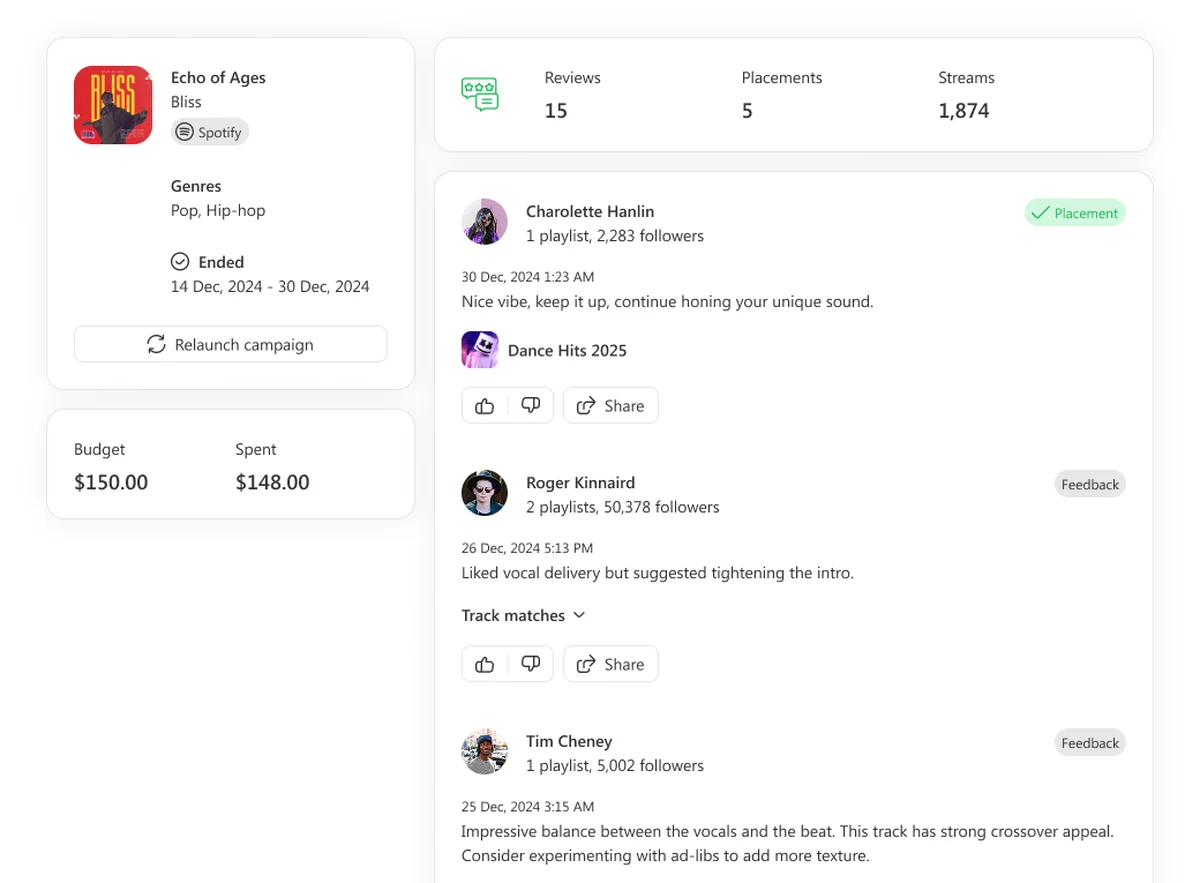
15 curators reviewed the track, 5 added it to a playlist, and it pulled 1,874 streams over two weeks. That works out to about $0.085 per stream. An independent test by Najinsan, running three services side by side, came out at $0.09 per stream on the same platform, two different artists in two different years landing on basically the same number. A separate reviewer, Noisetom, reported that around 15% of curators added his track, which lines up with the 5-of-15 rate above. What we didn't love: you're paying for consideration, not outcomes, and a campaign that lands badly still costs full price. Go in expecting data plus a modest streams bump, not a career change.
How do you tell a real curator from a fake playlist?
Check the ratio between a playlist's followers and its actual activity. Fake playlists are built to look popular rather than to be listened to, and that gap always shows up in the numbers.
Signals that a playlist isn't worth a pitch:
- 400+ tracks. Nobody listens past the first 30. Your song just gets warehoused.
- Follower count that doesn't match save behaviour. 50,000 followers and songs with a handful of saves each means the followers aren't real listeners.
- Every follower arrived in the same month. Steady growth is organic, a vertical cliff is purchased.
- It accepts every genre. A playlist with country next to drill next to ambient has no audience identity, so nobody trusts its recommendations.
- It charges per placement rather than per pitch. This is the clearest tell of all, and the next section explains why it matters so much.
- The curator promises a stream count. No honest curator can, because they don't control who presses play.
A playlist with 800 engaged followers in your exact genre is worth more than one with 80,000 hollow ones. The small one produces saves, and saves are what the algorithmic layer reads.
How do you pitch Spotify's editorial playlists?
Pitch editorial through Spotify for Artists 14-21 days before release, every single time, because it's free and every pitch is read by a human editor. Inside Spotify for Artists it's under Music → Upcoming → "Pitch a Song", and it takes about five minutes.
Two constraints to plan around. You get one pitch per release and the form locks once submitted, so there's no iterating. And the form won't accept anything closer than 7 days to release, which means editorial has to be scheduled into your release timeline rather than bolted on at the end.
Now the honest part: across the indie releases we've tracked, the editorial hit rate hovers around 3-5%. Still pitch it. Five minutes for a shot at a flagship playlist is obviously worth taking. Just don't let it be the whole plan, because artists who treat editorial as their strategy tend to end up with nothing at all. One lottery ticket, no backup.
It also compounds. Editors who read your pitch and passed still saw your name, and a stronger save rate next time makes the next pitch more likely to land. Editorial works like a relationship across several releases.
The pitch copy itself is its own craft. We covered it separately in how to pitch Spotify editorial playlists, including the character count that actually performs and a template you can copy.
How do you get picked up by Spotify's algorithmic playlists?
You don't pitch algorithmic playlists, you qualify for them by generating the listener signals they read. This is where people searching for how to get on playlists on Spotify usually end up disappointed, because there's no submission form to fill in.
The signals that matter most:
Save rate. The percentage of listeners who save your track is the strongest single input. A song with 500 streams and 60 saves will outperform a song with 5,000 streams and 20 saves in the algorithmic layer.
Completion, especially the first 30 seconds. An early skip actively counts against the track.
Follower growth. Release Radar pushes new music to your existing followers more or less automatically, so followers are the closest thing to a guaranteed algorithmic audience you can build.
Playlist context. Which user playlists your track sits alongside teaches Spotify who to recommend it to, which is one reason a genre-accurate curator placement is worth more than a bigger mismatched one.
The two routes aren't alternatives, which is the part that trips people up. Curator placements are the input that produces algorithmic output. Real listeners on a genre-matched playlist save the track, and those saves are what Discover Weekly reads. One feeds the other.
One caveat, since plenty of people will sell you certainty here: Spotify doesn't publish how it weights any of this. Anyone quoting you an exact save-rate threshold is guessing, us included.
For the full layer-by-layer breakdown of how these systems interact, see how the Spotify algorithm actually works.
Which route should you use for your genre?
Curator supply is genre-dependent, so the right route changes with what you make. Across six months of testing 23 promotion platforms in six genres, the pattern was consistent.
- Electronic, house, and hip-hop. The deepest curator pools by a wide margin. Platform pitching works well here because supply is genuinely there.
- Indie and bedroom pop. Strong curator supply, but heavy competition. Genre precision matters more than volume, "indie pop" and "bedroom pop" are different audiences.
- Lo-fi. Enormous playlist supply, but the most fake playlists of any category. Apply the checks above ruthlessly.
- Singer-songwriter and folk. Fewer, smaller, more personal playlists. Manual outreach performs unusually well here, because the curators are individuals with taste and they read their own messages.
- Metal and heavy genres. Thinnest supply on the platforms. A hand-built list of scene playlists and blogs beats any pitching service here.
If you're in a thin-supply genre, spend your money on ads and your time on manual outreach instead. Paying any platform, SoundCampaign included, to pitch curators who don't exist in your genre is the most predictable way to waste $150. Check which genres a service actually covers before you buy, and treat a vague answer as a no.
What does a realistic playlist campaign timeline look like?
Plan on roughly seven weeks from first move to readable data. The two pitching routes have completely different deadlines, which is what makes the sequencing fiddly.
4 weeks before release. Finish the master. Claim Spotify for Artists if you haven't, and fill out your profile properly.
3 weeks before release. Submit the editorial pitch. This is the hard deadline, miss it and that route is gone for this release.
1-2 weeks before release. Line up your curator campaign so pitches go out on or just after release day. Build the pre-save page.
Release day. Editorial decisions are made by now. Curator pitches start going out.
Days 3-14. Curator placements land. This is when most of your placement activity happens.
Days 7-28. Algorithmic reaction, if it comes. Release Radar hits your followers in week one, Discover Weekly needs more accumulated signal.
Day 30. Read the data and decide what to repeat. Anything earlier is noise.
For the full pre-release sequence around this, see the pre-release marketing checklist.
Why do services that guarantee streams or placements put your music at risk?
Because a guarantee is only possible two ways: the placement got bought, or the streams are fake. Both violate Spotify's terms.
Artists conflate three different transactions here:
- Paying for pitching or review. Allowed. You're buying a curator's time to consider your track, and they can still decline.
- Paying for the placement itself. Not allowed. This is payola, and the playlists that do it tend to have hollow follower counts anyway.
- Buying streams. Not allowed, and the most damaging of the three. This is bot traffic.
Here's the mechanism. Spotify's anti-fraud systems look for traffic patterns that don't match real listening, and for traffic that doesn't match your audience profile. When either trips, the streams get nulled and your account gets flagged. Remediation is slow and limited. In the worst case a release gets pulled entirely.
Run the arithmetic on the offers, too. Our own tracked campaign produced streams at about $0.085 each through legitimate curator pitching. An ad offering "10,000 streams for $30" is pricing streams at $0.003, which is roughly what Spotify pays out per stream. Nobody sells you real listening at cost. What they're selling is bot traffic, and you're paying to have your catalog flagged.
One question sorts the legitimate services from the rest: can the curator say no? If placement is promised no matter what, whatever you're buying isn't pitching. A compliant model looks like the one SoundCampaign runs, where you pay for curator review time, curators genuinely decline, no placement is promised, and pitches that never got reviewed are refunded.
How do you know a placement actually worked?
Open Spotify for Artists and look at saves per placement. Streams only tell you people arrived. Saves tell you they came back, which is the number that predicts anything.
What to read 30 days after release:
Source of streams, broken out by playlist. This tells you which specific placements did the work. Most campaigns have one or two placements carrying everything.
Saves per placement. A playlist that sent 400 streams and 2 saves sent you traffic. One that sent 90 streams and 25 saves found your actual audience. Pitch that second curator again.
Follower delta. Followers are the input to Release Radar on your next release, so this is the number that compounds.
Whether listeners came back. Returning listeners in weeks 3-4 are the clearest sign a placement reached real people.
Worth knowing: Judge a playlist campaign on what the audience cost you, not on royalties. Streams bought through curator pitching cost us about $0.085 each, while Spotify's blended payout sits somewhere around $0.003 to $0.005 per stream. You will not recoup a campaign on royalties, and any service implying otherwise is selling a fantasy. What you're actually buying is listeners, saves, and follower growth that make the next release cheaper to promote. Judge it on that.
That reframe also answers the question artists usually ask next, which is how to get on more playlists. More pitching isn't it. Keep the curators who kept you, drop the ones who sent hollow traffic, and a shortlist of 15 curators who've added you before will outperform 50 cold pitches next release.
Ready to pitch curators instead of guessing?
Run a campaign through SoundCampaign and reach up to 15 genre-matched curators, with real feedback on every one, even the ones who pass.
Related reading
FAQ
How do you get onto Spotify playlists?
Three ways, and only three. Pitch independent curators who run their own playlists, pitch Spotify's editorial team through Spotify for Artists, or earn algorithmic placement (Release Radar, Discover Weekly) through save rate and follower growth. Everything else being sold to you is one of these three, repackaged, or a policy violation.
How much does it cost to get on a Spotify playlist?
Independent curator pitching runs around $150, which reaches up to about 15 genre-matched curators and typically returns about 5 placements. Spotify editorial pitching is free and takes about five minutes. Algorithmic placement can't be bought at all. Paying for a placement itself, rather than for a curator's time to consider your track, breaks Spotify's rules.
Can you pay to get on Spotify playlists?
You can pay for a curator to review your track. You cannot pay for the placement itself. That distinction is the whole game: a legitimate service sells you pitches and the curator can still say no, while a service that guarantees placement is either buying the slot or generating fake streams. Both put your release at risk.
How long does it take to get on a Spotify playlist?
Independent curator placements typically land 3–14 days after you pitch. Editorial pitches must be submitted 14–21 days before release and are decided by release day at the latest. Algorithmic placement builds over the 7–28 days after release, as Spotify accumulates enough listener signal to act on.
How do I get on more Spotify playlists?
Volume and fit, in that order. Pitch more genre-matched curators per release, pitch every release rather than only the ones you think are singles, and keep the curators who added you last time on a shortlist. One well-matched pitch beats ten scattergun ones.
Newsletter
The MelodicMind brief
One short email a week. New reviews, music-industry news, and what we're working on. Free, unsubscribe in one click.
Related reading